

What I Learned About Reverse Mortgages as an Underwriter
An honest look at reverse mortgages from the underwriting side
Some mortgage files stay with you.
Not because they were complicated, but because of the people sitting on the other side of the desk.
Over the years, I underwrote reverse mortgages for retirees trying to stay financially afloat in homes they had owned for decades. I also underwrote refinance transactions for heirs scrambling to keep those same homes after a parent died or moved into assisted living.
I have watched reverse mortgages relieve enormous financial pressure for seniors living on fixed incomes. I have also watched adult children discover foreclosure notices taped to the front door of a family home they thought had already been “paid off.”
That is why reverse mortgages are so emotionally misunderstood.
They are neither the financial disaster critics often claim nor the magical retirement solution some advertisements promise. They are simply complicated financial tools that can work very well for some borrowers and very poorly for others.
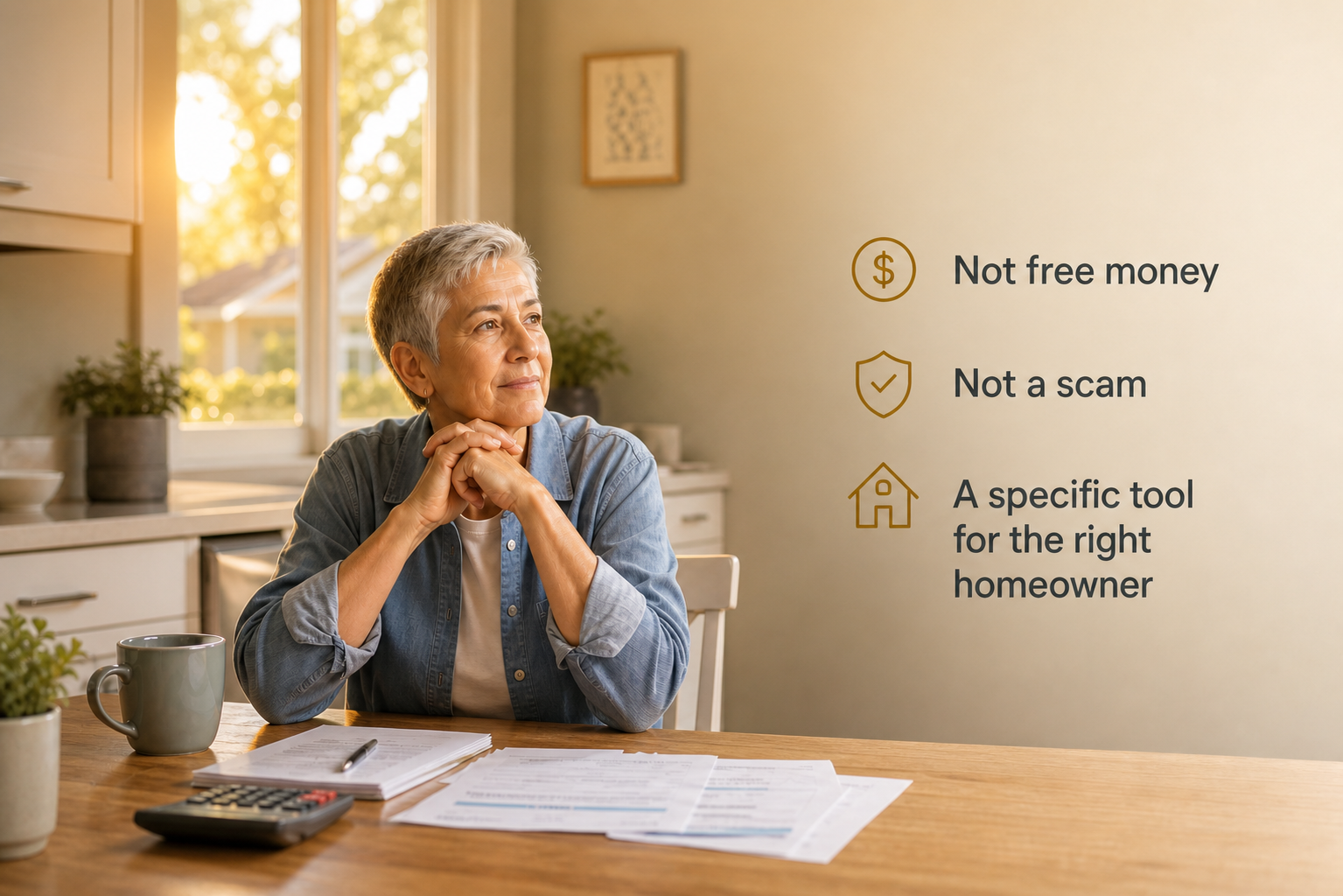
A reverse mortgage is not free money. It is not automatically a scam either.
It is a very specific mortgage product designed primarily to help older homeowners remain in their homes by converting part of their equity into usable cash during retirement. For the right borrower, it can create breathing room during a stage of life when rising costs and limited income begin colliding head-on. For the wrong borrower, it can become an expensive solution that creates confusion and stress for surviving family members later.
The reality is much more nuanced than the commercials make it sound.
How a Reverse Mortgage Actually Works
The reverse mortgages I underwrote were primarily HUD-insured Home Equity Conversion Mortgages (HECM)s. There are also proprietary reverse mortgage products offered by private lenders, but my experience was primarily with the federally insured HECM program.
At its core, a reverse mortgage allows homeowners aged 62 and older to borrow against their home equity without making a monthly mortgage payment. Instead of the borrower making monthly payments to the lender, as in a traditional mortgage, the loan balance grows over time as interest accrues on the outstanding balance.
That distinction matters because many people confuse reverse mortgages with cash-out refinances or home equity lines of credit (HELOCs), but they function very differently.
With a traditional cash-out refinance, the borrower replaces their existing mortgage with a new, larger loan and immediately begins making monthly principal and interest payments. With a HELOC, the homeowner gains access to a revolving line of credit but still has required monthly payments once funds are used. Reverse mortgages eliminate the required monthly mortgage payment, which is exactly why they can be so useful for retirees living on a fixed income.
That does not mean the borrower suddenly has no housing obligations.
Property taxes still have to be paid. Homeowners insurance must remain active. The home still has to be maintained. HOA dues still matter. One of the biggest misconceptions I saw over the years was the belief that a reverse mortgage somehow eliminated all financial responsibility tied to the property. It does not. In fact, underwriters specifically evaluate whether the borrower is financially capable of maintaining the property in the long term.
Interestingly, reverse mortgage underwriting is less focused on credit scores than traditional lending. HUD does not require a minimum credit score for a HECM reverse mortgage. Instead, the underwriting analysis focuses more on whether the borrower can reasonably continue paying taxes and insurance and maintain the home itself. If there are concerns about the borrower’s ability to handle those obligations, the lender may require a Life Expectancy Set Aside (LESA), in which part of the reverse mortgage proceeds is reserved specifically to cover future property charges.
That surprises many people because they assume “no payment” means “no qualification.” That is not how it works.
The amount someone can borrow with a reverse mortgage is based on several factors. Age plays a major role. Generally speaking, the older the borrower, the more they may qualify to receive, because actuarially the loan is expected to be outstanding for a shorter period of time. The amount of equity in the home, current interest rates, and the property’s appraised value also matter. HUD also caps the maximum claim amount used in the calculation process.
The youngest borrower’s age matters too, which sometimes catches married couples off guard when one spouse is significantly younger than the other. The loan amount calculation will be based on the younger of the two borrowers.
The actual structure of how borrowers receive the money is also far more flexible than many people realize. Some borrowers take a lump sum at closing, often to pay off an existing mortgage or eliminate debt. Others choose monthly tenure payments that function almost like supplemental retirement income for as long as they remain in the home. Some select term payments for a specific number of years. Others use a line-of-credit structure and only draw funds when needed.
Even lump-sum distributions are not always as straightforward as people assume. HUD typically limits how much can be withdrawn upfront during the first year, unless mandatory obligations, such as paying off an existing mortgage, require more. Reverse mortgage proceeds are also generally considered tax-free because they are loan proceeds tied to home equity rather than earned income.
I actually saw some borrowers use the line-of-credit option strategically during market downturns. Rather than liquidating retirement accounts during a bad market, they would temporarily use reverse mortgage funds to supplement cash flow and preserve investment accounts until markets recovered. Used carefully, the product can create flexibility that many retirees simply do not have otherwise.
Mortgage Lending Explained is a reader-supported publication. To receive new posts and support my work, consider becoming a free or paid subscriber.
The Costs and Long-Term Tradeoffs
But none of this comes without cost.
Reverse mortgages can carry substantial upfront fees compared to traditional mortgage products. Origination fees, closing costs, FHA mortgage insurance premiums, servicing costs, and accrued interest all contribute to a loan balance that grows over time rather than shrinks. Some of these costs can be financed into the loan itself, which helps borrowers avoid large out-of-pocket expenses upfront, but financing those costs also increases the balance owed later.
And yes, that balance can eventually exceed the home’s value.
This is where many people become confused or fearful, but federally insured HECM reverse mortgages include non-recourse protections. Neither the borrower nor the heirs is personally liable for more than the property’s value when the loan becomes due. If the housing market declines and the reverse mortgage balance exceeds the home’s value, FHA insurance absorbs the shortfall, not the family.
This is commonly referred to as the 95% Rule. Under this rule, heirs can satisfy the reverse mortgage by selling the property for at least 95% of the appraised value, even if the loan balance itself is higher. This protection prevents families from inheriting a debt larger than the home’s market value.
On the other hand, if the property appreciates significantly over time, there may still be substantial equity remaining after the reverse mortgage is repaid. I think this is another area where people oversimplify these loans. Some assume the bank automatically “takes the house” no matter what happens. That is not accurate. The outcome depends heavily on the home’s appreciation, the amount borrowed, the length of time the borrower remains in the property, and the interest that accrues over the life of the loan.
What Happens When the Borrower Dies or Leaves the Home
Things often became emotionally difficult after the borrower passed away or permanently left the home.
Most reverse mortgages become due and payable when the last borrower dies, sells the home, or no longer occupies it as a primary residence. Assisted living situations frequently trigger repayment because the borrower is no longer living in the property full-time.
I have seen adult children completely blindsided by this process because they assumed the home would simply transfer automatically through inheritance, while the reverse mortgage somehow remained in place indefinitely. That is not how these loans work.
Technically, HUD timelines can sound alarmingly aggressive when families first receive notices from the servicer. But in practical terms, most servicers will work with heirs who are actively communicating and making progress toward resolving the loan. I underwrote refinance transactions for heirs who wanted to keep family homes, and many of those files took longer than the initial timelines families feared.
Communication is everything in these situations.
If heirs are responsive, provide updates, attempt to sell the property, or actively refinance the loan, foreclosure can often be avoided. Problems usually start when there is no communication at all. Servicers cannot indefinitely hold unresolved reverse mortgage files open without movement toward resolution.
One file has stayed with me for years. A daughter had moved in with her aging parent to help provide care. She knew enough to continue paying the taxes and insurance after the parent moved into a care facility, but she did not fully understand the reverse mortgage itself or that the loan had become due once the home was no longer considered the borrower’s primary residence. The mortgage servicer had no idea she was living there.
By the time the transaction reached underwriting, foreclosure proceedings had already started, and the refinance became an extremely stressful rush because the daughter had also left her job to become a caregiver. Qualifying for a mortgage under those circumstances became very difficult. Watching someone sit in a loan officer’s office, terrified they might lose the family home, is not something you easily forget.
Why Reverse Mortgage Conversations Matter
Situations like that are why I strongly believe these conversations matter. Not because adult children need to approve a parent’s financial decisions, but because life changes quickly. Illness, assisted living, memory care, and death are emotionally difficult enough without families also trying to untangle a mortgage they never knew existed or never fully understood.
Reverse mortgages are complex enough that HUD requires borrowers to complete independent counseling before the loan can move forward. Honestly, I think that requirement exists for good reason. This is not the type of mortgage someone should obtain after hearing a quick sales pitch or watching a late-night television commercial. A knowledgeable HECM specialist should be able to clearly explain the costs, repayment triggers, long-term implications, and possible alternatives before anyone signs paperwork.
The truth is that reverse mortgages can absolutely be valuable financial tools for the right homeowner. I have seen them help seniors stay independent, remain in homes they loved, and relieve financial pressure during retirement. I have also seen situations where costs, shrinking equity, or family misunderstandings later created stress.
Like most things in mortgage lending, reverse mortgages are neither universally good nor universally bad. They are simply complicated financial tools that work very well in some situations and very poorly in others.
The key is understanding exactly what problem the loan is solving before signing the paperwork.
