

Author’s Note:
This is a personal account of my family’s experience. Formal complaints have been submitted to the appropriate agencies. I am sharing this because I believe vulnerable patients deserve thoughtful discharge planning, transparency, and properly credentialed professionals involved in their care, and because my brother asked me to.
A Journey That Shouldn’t Have Happened
Most of the time, I write about the joy of the journey.
The hidden cafés. The beautiful sunsets. The thrill of learning about different cultures.
This is not that kind of travel story.
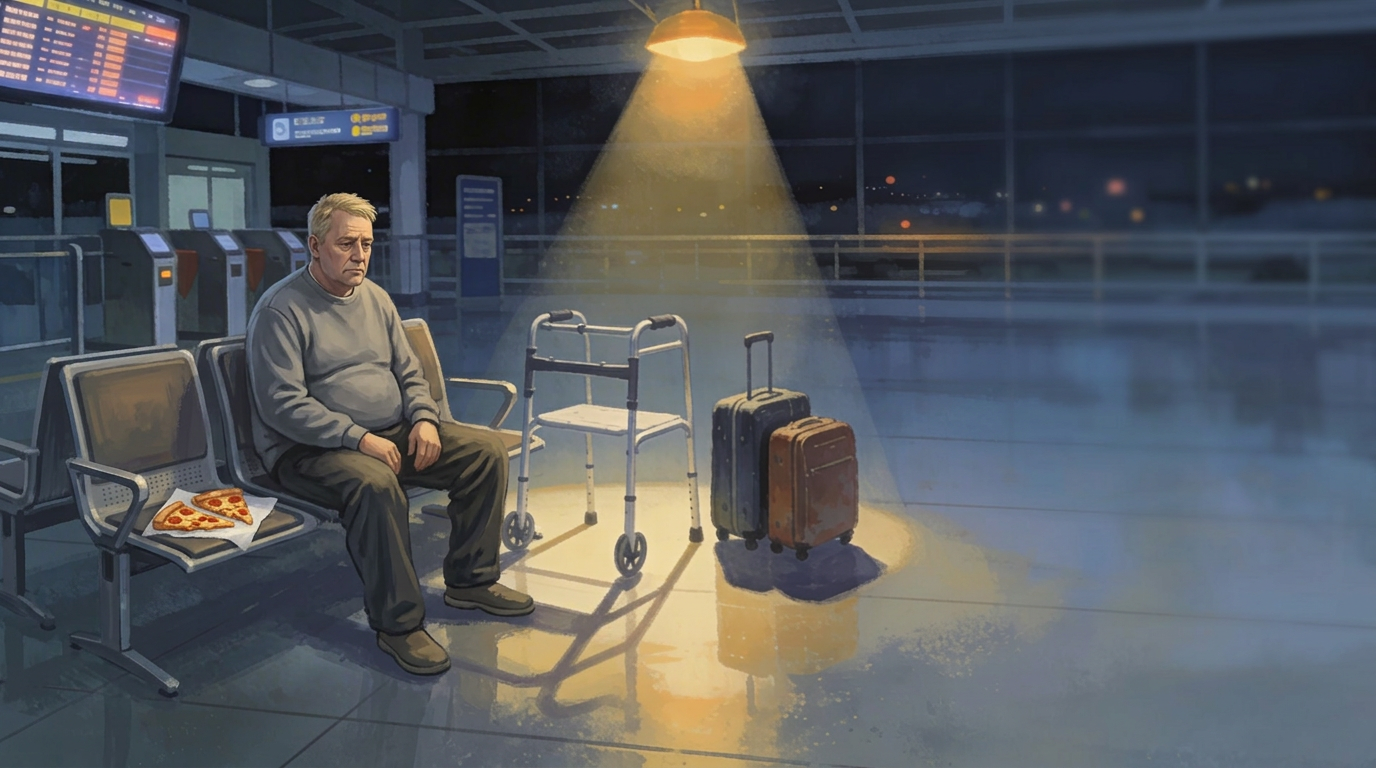
This is a story about a 2,000-mile trip that never should have happened. A trip set in motion by discharge practices at Lumina Behavioral Health. A trip that was held together, quite literally, by two slices of pizza shared by a stranger in an Oklahoma bus terminal.
My brother, Mark, is not a backpacker or a tourist.
He is 58 years old. He lives with congestive heart failure and COPD. He walks with a walker. He wears heavy braces that run from his feet to just below his knees. When he stands too long, his legs swell and darken.
He has struggled with addiction. He has made mistakes. He is an imperfect man.
He is also gentle. And trusting. And far more hopeful than the world has often deserved.
And he believed he was loved.
Last October, while Mr. Whaldo and I were transiting the Panama Canal, I received a message from my mother.
“I have news about Mark, but it would be a really long text, so perhaps you can call when you get home. He is alive and with us, so don’t panic.”
I have been preparing myself for my brother’s death since I was fourteen. His life has been chaotic, self-destructive, and medically fragile. So the words “he is alive” did not make me gasp. They simply reminded me that the story was still going.
Promises of Care, Words of Family
Mark had been at Lumina Behavioral Health in Arkansas for about a month. For the first time in his life, he admitted he needed help and checked himself in.
When I spoke with him there, he sounded lighter than I had heard him in years. Almost boyish.
He told me they loved him.
Not that he felt supported. Not that he felt encouraged. He said they told him they loved him. He said they called themselves family.
He said they were helping him apply for subsidized housing. He said they would help him furnish it when the time came. That they would make sure he was taken care of.
I remember feeling that small tightening in my chest.
Who told you that?
What exactly did they promise?
Why would they be furnishing an apartment?
He didn’t like my questions. He wanted to believe he had landed somewhere safe. Somewhere that saw him as more than his history.
I ended each call with him, encouraging him forward and begging him to get some facts about his next step.
The Hidden Burden of Trusting a Behavioral Health Facility
When I called my mother after we returned home, her voice was “off”. You know that voice that people get when they are trying with everything in themselves to hold it together, to sound confident while they are holding their back rigid and trying to get through the moment? That was the voice.
She told me Lumina had told Mark to leave. They needed the bed. His approved housing unit was not yet available. If she did not take him, he would be homeless.
Homeless.
My 58-year-old brother with heart failure, leg braces, and a walker. Homeless.
My mother insisted on speaking directly with the Case Manager, Tammy. The next day, my daughter, JD, sat beside her with the phone on speaker so someone else could hear exactly what was being said.
Tammy explained that Mark would be bused from Arkansas to Arizona to stay temporarily with my mother. Lumina would pay for transportation. Once housing was ready, or once the agreed period had passed, they would arrange to bring him back.
My mother was clear. She was preparing to move into assisted living herself. She had a small extra bedroom and an air mattress. She could not take him indefinitely. She would not pay for the transportation. There had to be a final timeline.
She asked questions. She repeated back what she was told. She clarified the timelines, the responsibilities, and what Lumina would provide. She believed she was having a responsible, adult conversation with a licensed professional. She trusted the words she was given.
The agreement was made. Mark would leave Lumina, travel to Arizona, stay no longer than six weeks, and Lumina would cover his return to Arkansas. His housing would continue under their guidance until government housing became available. Everything had been spelled out, agreed to, and, in her mind, secured.
From Agreement to Abandonment: The Midnight Journey Begins
Within days, my brother was dropped off outside a bus station at midnight. He sat outside with his walker and a single box of belongings until the station opened at 1:30 AM. He spent the next day and a half on a bus to Arizona.
He arrived in Arizona exhausted but hopeful. Before he left Lumina, Tammy had instructed him not to tell housing officials that he was already there, so he followed that direction carefully. He attended NA meetings and tried to do everything he had been told to do. He called Lumina for updates and left messages. He sent texts. He waited for someone to call him back, believing there was still a plan in motion.
When his medications were running low and calls were still not returned, my mother scrambled to arrange refills locally.
Three weeks passed.
No housing update.
No return ticket.
No follow-through.
My mom started leaving messages for Tammy at Lumina.
Promises Broken: When the Plan Collapses
When my mother finally reached Tammy, the tone was completely different. The agreement they had made—the timeline, the bus ticket, the promise of return, the housing support—was denied. Tammy told her that Mark needed to “do the adult thing.” That it was no longer Lumina’s responsibility. It was now a “family matter.”
A family matter.
Mark was on speakerphone. My mother was trying to remain calm. JD, my daughter, was listening in. The conversation became dismissive, impatient, and rude. JD stepped in, asserting the facts of the agreement and defending both her uncle and grandmother. Tammy ended the call abruptly.
That afternoon, my mother called me from her car. She was sobbing. Not angry. Not loud. Just… broken.
She felt trapped, manipulated, and powerless. “I feel so stupid,” she kept saying. “I should have known better. I can’t believe I believed them. I feel so stupid.”
My mother is not stupid.
She is careful. Thoughtful. She raised children, managed finances, and navigated crises. And yet, Lumina made her feel as if she had misunderstood something that had been clearly promised. That humiliation settled into her voice like a weight, dragging it down.
That is the moment I knew it was time for me to get involved.
Stepping In When the System Fails
I could not stand by while my mother and my brother were left to navigate this alone. I needed to understand exactly what had happened and to make sure someone was held accountable. I also needed to figure out what to do with my brother. My mother’s move was approaching quickly.
Research came first. I confirmed that Tammy was not a licensed case manager and that she was the sister of Diane Bynum, CEO of Lumina Behavioral Health. I left a detailed message for Ms. Bynum requesting a call. She returned my call, and I laid out the facts as I knew them. I followed up with a formal letter of complaint, sent via Certified Mail with Return Receipt.
Meanwhile, Mark’s children in Missouri were mobilizing. His youngest, who worked at a nursing home, began gathering all of his medical records from Lumina to see if they could arrange a safe transition for him. Crystal at Lumina retrieved the documents from Tammy and sent them to Mark’s daughter. Step by step, the pieces started to come together, and finally, a plan emerged to move him to a nursing facility that could meet his complex needs.
Given his heart failure, limited mobility, and COPD, independent housing would have been precarious at best. The nursing facility was stability. It was appropriate care.
I purchased a Greyhound ticket. Flying was not feasible because the logistics and cost at the receiving end were too much. On paper, the itinerary looked manageable. Depart Phoenix late evening, arrive in Oklahoma, connect to Memphis, then the final leg to Jonesboro, where his daughter would pick him up and admit him the same day.
The Long Journey Begins
But reality had other plans. The first bus was delayed more than twelve hours because there was no driver. No one could tell him when one would arrive. So he waited.
He sat in the Phoenix terminal with two rolling suitcases and his walker positioned in front of him like a barrier. The café was closed. He rationed the snacks he had packed, counting them out in his head so they would last. He limited his water so he would not have to wrestle his belongings into a restroom stall and risk someone walking off with what little he had.
He did not sleep. He was afraid to close his eyes. Afraid the bus would be called. Afraid his name would be said, and he would miss it. Afraid of being left behind.
By the time he reached Oklahoma, he had missed his connection.
Another 12-hour wait.
Two Slices of Human Kindness
By then, his legs were swollen. The braces dug into his skin with every small shift.
He watched other passengers receive food vouchers because of the delay. When he asked, none had been issued in his name. No one could explain why.
The clerk behind the counter leaned close and quietly told him that she had ordered a pizza for herself and would share it with him. Hours later, she returned with two slices.
Hot. Greasy. Ordinary.
And for a moment, everything felt a little lighter. He still smiles when he talks about that pizza.
Swollen. Exhausted. In pain. He eventually reached Missouri. Because the delay pushed his arrival to Sunday, the nursing facility could not process admission until Monday morning. He spent one night on his daughter’s couch before finally being admitted.
Silence And Indifference
During that same time, I received a letter from Diane Bynum, CEO of Lumina, stating that she had called Mark, but he did not want to talk to her. Since Mark did not wish to continue discussing the matter, she considered it closed.
The implication was clear. In her opinion, his silence meant resolution.
Mark had been instructed to stop engaging. He has a tendency to overshare, to explain, to try to smooth things over. That instinct does not serve him in situations where power is uneven. His quiet was not consent. It was caution. He now knew that he was not loved by these people; he was a number attached to a dollar sign.
Finding Steady Ground
He is safe now. His medications are on schedule, his legs are monitored, and the daily aches that once ruled him have softened. He talks about books again, makes small plans with his family, and cherishes his time with his grandchildren. For the first time in a long while, life feels steady. The frantic uncertainty that shadowed his life for so long has finally loosened its grip, and for the first time in years, he can just be.
My brother tells me repeatedly how lucky he feels.
Lucky for his daughter, who found him a bed.
Lucky for the clerk who shared her dinner.
Lucky for a sister who refused to let the story end at a bus station.
But healthcare should not rely on luck.
Discharge should be a coordinated handoff, not a hurried vacancy. It should involve clear communication, licensed professionals, and a documented plan. It should never involve pressuring an elderly mother with the implication that refusal equals homelessness.
Healthcare Accountability Over A Bus Ticket
This story is not about a bus ticket.
It is about accountability.
It is about ensuring that vulnerable patients are not moved along because funding cycles change. It is about making sure titles reflect credentials. It is about remembering that behind every “discharge” is a human being who might have braces on his legs and medications that cannot be missed.
I have filed formal complaints with the appropriate oversight agencies. Not because I expect reimbursement. Not because I am seeking revenge.
But because the next family may not have someone who asks questions.
The next patient may not have a daughter with connections.
This ordeal revealed a harsh truth: a system designed to care for vulnerable people could, if left unchecked, abandon them entirely. In this case, it took a family willing to dig for answers, document every interaction, and insist on accountability to turn that story around.
Lessons from the Journey
When I write about travel, I often say that journeys change us. This one did.
It reminded me of the people I have met along the way who offer kindness without expectation. The bus depot clerk who shared her pizza was one of them. Moments like that stay with you, small reminders of how much simple human kindness still matters.
My brother reached his final destination because of the love and persistence of his true family, not because the road was made for someone like him.
And that is a journey no one should ever have to take.
-J.S. Whaldo
