

Staycation in San Diego: Finding Wonder at the San Diego Zoo Safari Park
Every now and then, a day turns into something more than you expected.
You leave the house thinking you're going to visit a wildlife park, and somehow you end up talking to volunteers about endangered condors, watching elephants care for their family, squatting on the floor to catch a glimpse of a platypus, and witnessing a baby deer meet the world for the first time.
That was our day at the San Diego Zoo Safari Park.
Spread across 1,800 acres in the San Pasqual Valley, the San Diego Zoo Safari Park is home to more than 3,000 animals representing over 293 species, many living in expansive habitats designed to mimic their natural environments. For comparison, the San Diego Zoo covers about 100 acres and is home to more than 12,000 rare and endangered animals representing over 650 species and subspecies.
The result is two very different experiences. The Zoo feels like a global wildlife journey through diverse exhibits, while the Safari Park feels more like traveling through large wildlife reserves where animals have room to roam.
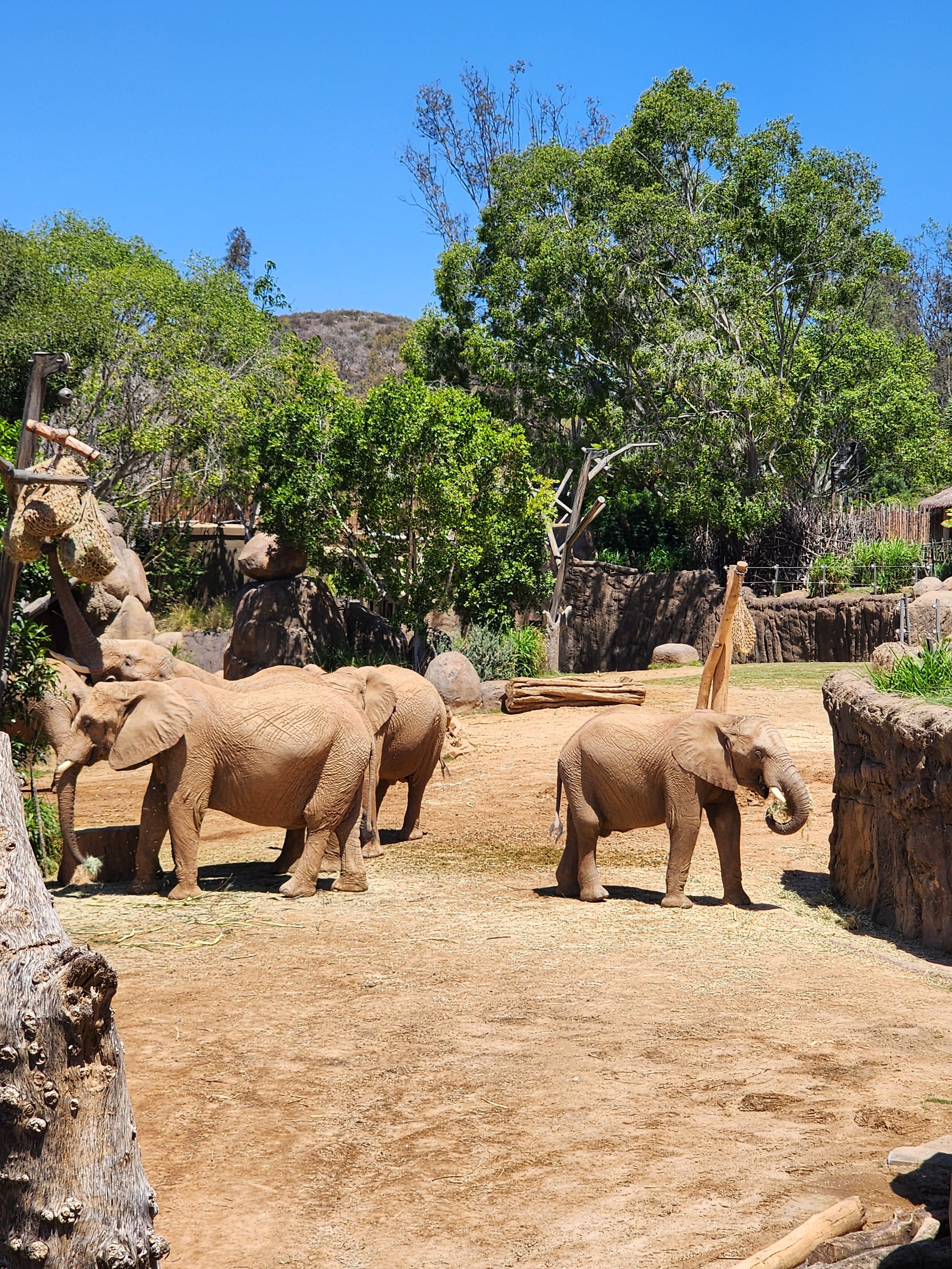
We arrived shortly after the park opened and headed straight to the newest habitat, Elephant Valley. Opened in March 2026, this beautiful exhibit spans more than 13 acres and is home to a herd of eight African elephants. It is designed to be an engaging habitat for the elephants while allowing visitors to walk alongside the giants on raised pathways and stop at various overlooks to observe them from different angles.
It is a very well-designed habitat where people can watch the fascinating family dynamics and elephant behaviors unfold naturally.
Elephant Valley and the Famous Earthquake Herd
I have always been mesmerized by elephants, but this particular herd was one I really wanted to sit and watch. The herd is led by Swazi, the matriarch. This herd became known worldwide after a 5.2 magnitude earthquake struck Southern California in 2025. Cameras captured the elephants instinctively forming a protective alert circle around the younger members of the herd. If you have never seen the footage, it is worth looking up.
At the time of the earthquake, I was sitting on the twentieth floor of the courthouse for jury duty and was far too busy being dizzy as the building swayed beneath me. When I saw the footage that evening, I knew we needed to visit this park as soon as Elephant Valley opened to the public.
As we watched the herd, we learned that three of the oldest females had been rescued and brought to the zoo together years ago. All three eventually had calves within a relatively short period of time and formed an incredibly strong family bond. One of the volunteers explained that the elephants receive enrichment activities every day, including food hidden throughout the habitat, so they have to search for it, much like they would in the wild.
The matriarch always gets first dibs, but she is also responsible for making sure everyone in the family gets their share. I loved that.
I also loved learning that the three rescued females have remained together all these years and will spend the rest of their lives together. They have formed their own family. It is that way for people too.
It was a quiet day at the park, which allowed us the luxury of lingering at habitats and observing without feeling like we were blocking anyone's view. Even around the elephants, one of the park's most popular exhibits, there was plenty of room to take our time and wander from one overlook to another to see what the herd was doing.
Exploring the Trails of the San Diego Zoo Safari Park
Eventually, we pulled ourselves away and headed toward the African Outpost to decide which safari we would take that day.
We opted for the Deluxe 90-minute cart safari that covered both the African and Asian plains. Since we still had more than two hours before our departure, we decided to walk the African Plains Trail, which would lead us to the other trails that would ultimately take us around a large portion of the park before returning us to our meeting point.
The weather was absolutely gorgeous, which led us to take our time. We stopped often to talk with volunteers, learning everything we could about the animals we encountered. One of the best volunteer stations in the park turned out to be the shaded overlook at the end of the African Plains Trail, where sweeping views of the African savanna stretched out before us.
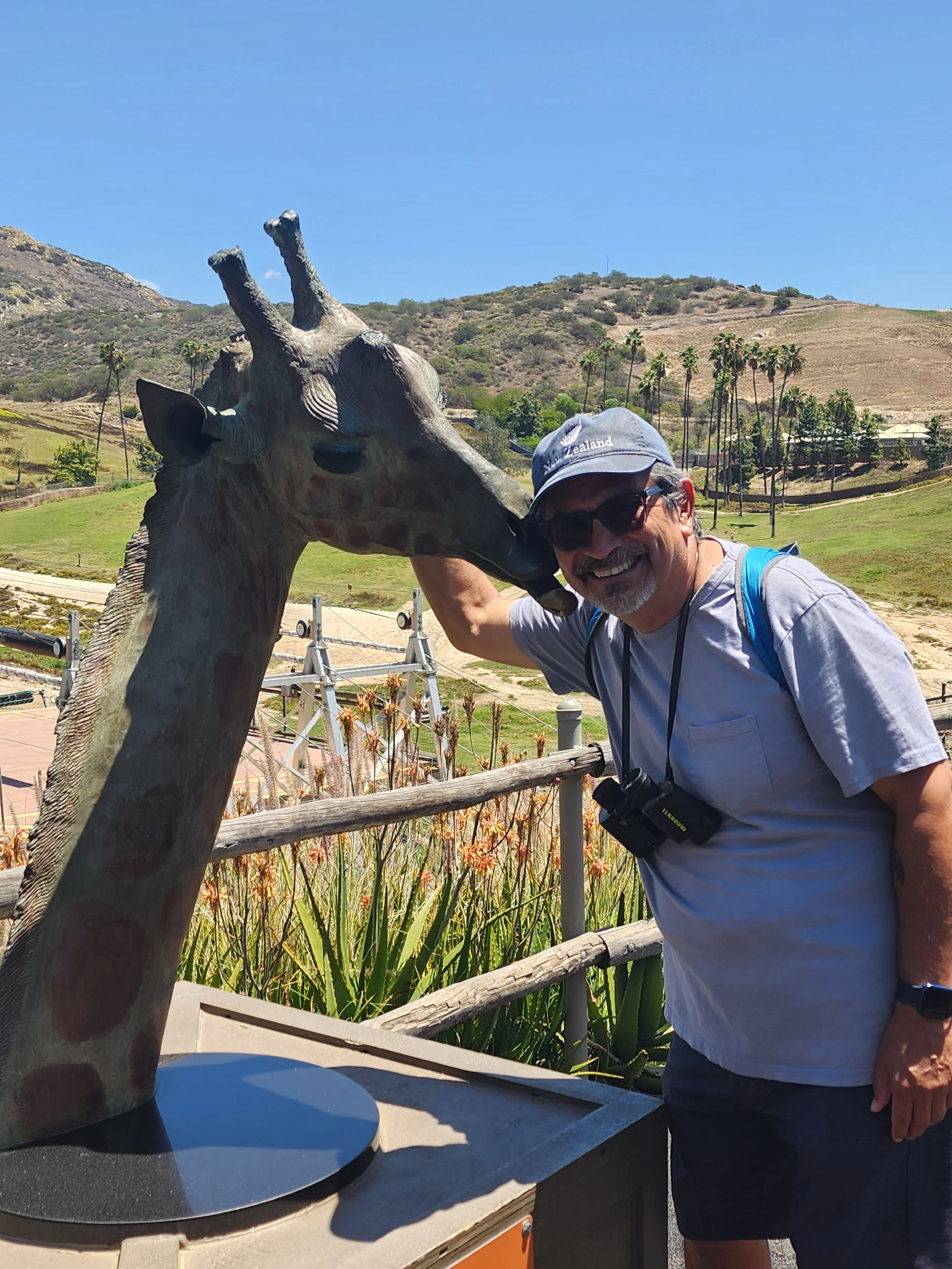
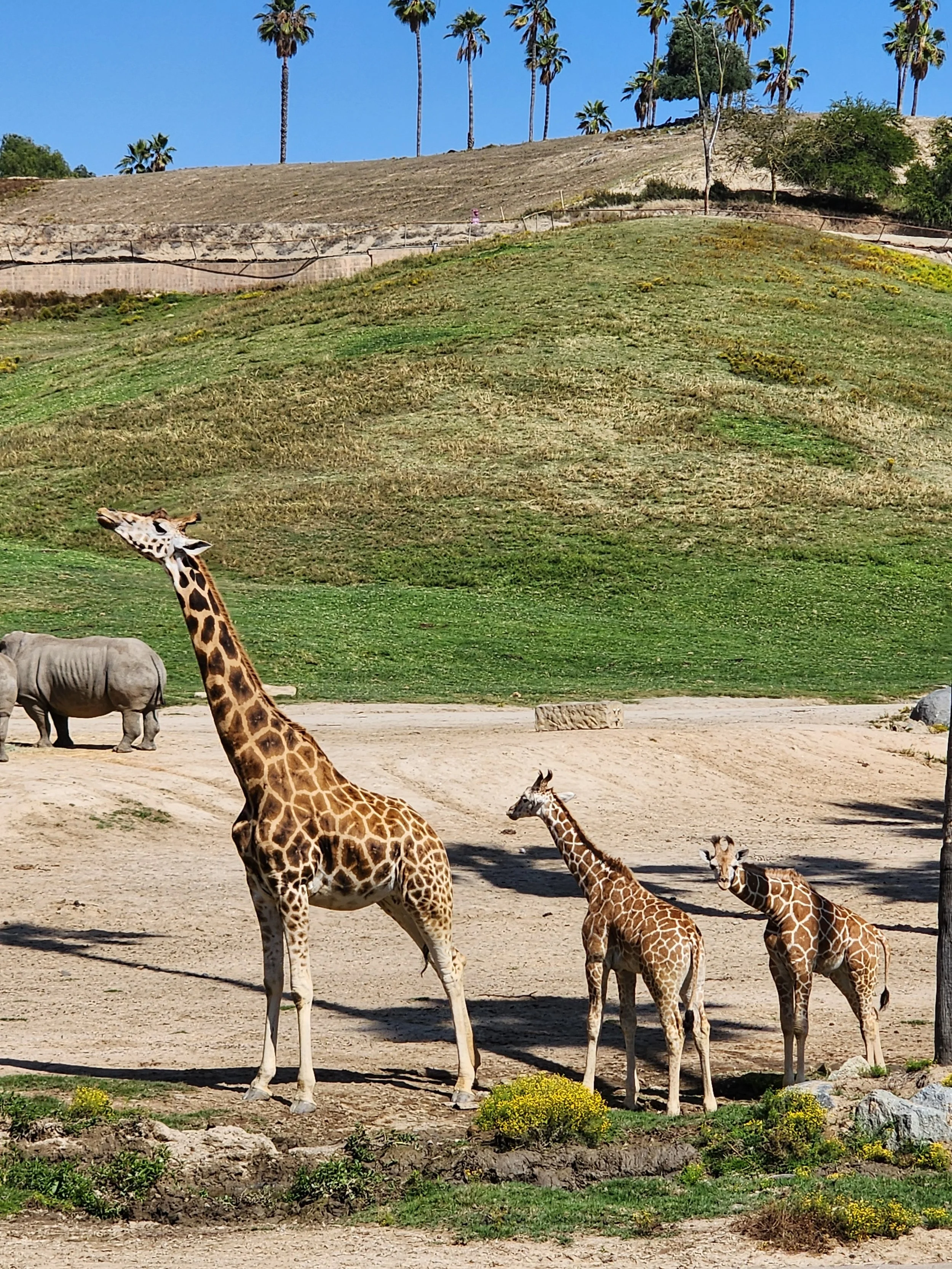
We stood there talking with a volunteer while watching a baby giraffe run, kick, bounce, and generally behave like a toddler who had just discovered legs. There is something endlessly entertaining about watching a young giraffe trying to figure out what to do with all those long, spindly limbs.
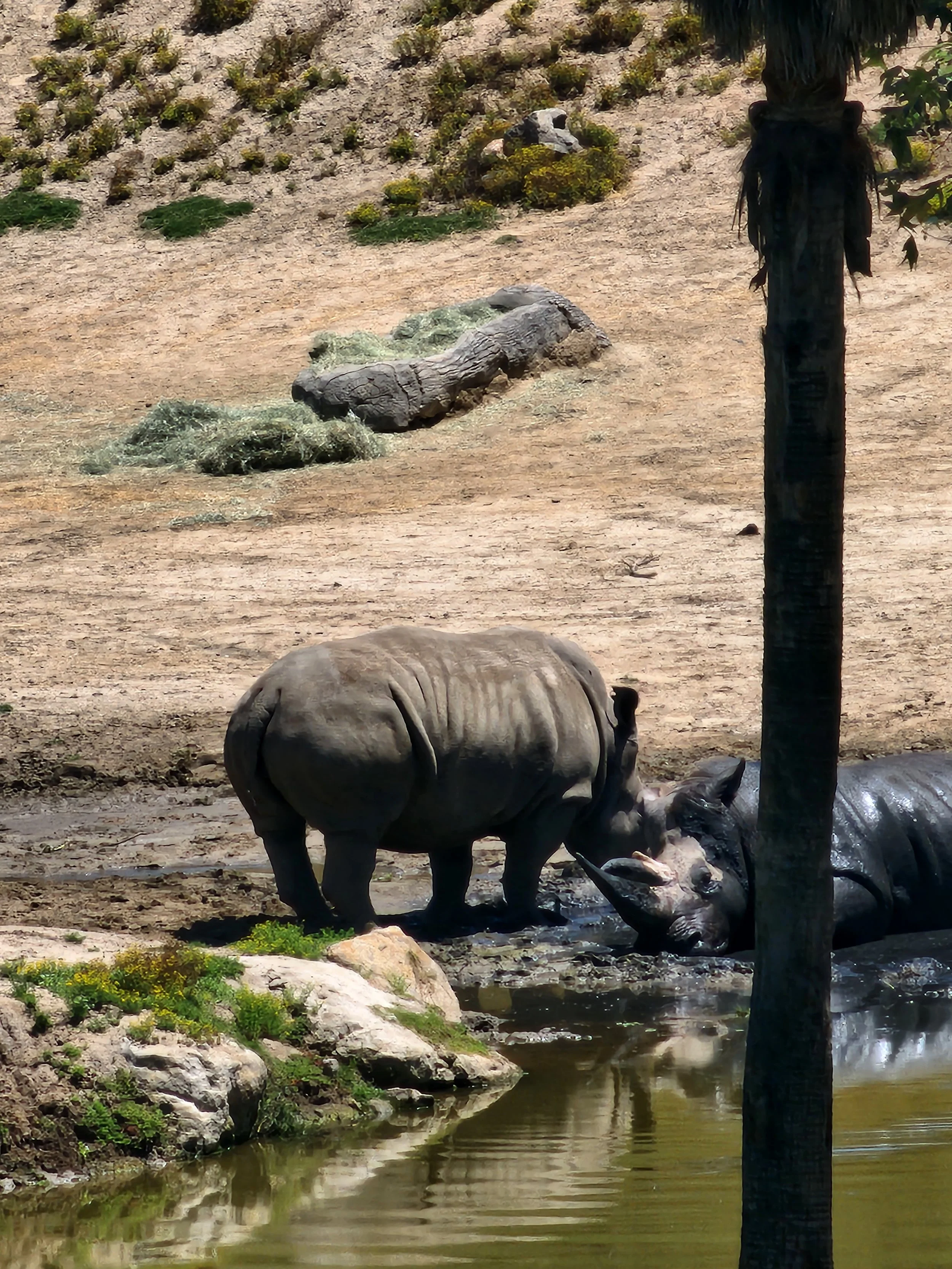
Nearby, several white rhinos were gently nudging each other while competing for the best mud-wallowing spot in one of the ponds. Meanwhile, Mr. Whaldo and I entertained ourselves by making up entirely fictional telepathic conversations that we decided they were having with one another.
The rhinos seemed very invested in the discussion.
We transferred to the Nature Trail and eventually made our way toward the Condor Trail. Along the way, a pair of ibis flew in, and that is when we learned for the first time that the White-faced Ibis calls San Diego home.
At that point, we were fully bird-geeked out.
A Conservation Story Comes Full Circle
When I was growing up, I used to sit in the school library (or bookstore) and read National Geographic. One of the stories that I remember with certainty was about the California Condors and how they had become extinct due to various poisons like DDT, lead poisoning, and predator poisoning. Being scavengers, they were the ultimate unknowing victims. Their numbers had dropped to only 22 living Condors in the wild by 1982.
In 1987, a highly controversial decision was made to capture the remaining condors and begin a long, difficult captive breeding program. This was led by the San Diego Zoo Safari Park and the Los Angeles Zoo.
As we approached the regal, lone California Condor perched on a large branch in his enclosure, I started telling Mr. Whaldo about it. As I spoke, with tears in my eyes, I told him that I had always followed their progress and that the great efforts had now led to the California Condor's return to the wild, and that their numbers were slowly increasing again.
At that point, the volunteer there walked up and happily filled in the blanks for me, including how the population is now over 500, with more than half of those flying free. He explained that we were looking at one of the breeding males at that moment. He also explained how they use puppets to raise the chicks so that they do not imprint on humans and can be released into the wild.
Conservation efforts continue to this day. Laws have been changed, and the California Condor is protected under federal and state laws, making it one of the most heavily protected and guarded birds in the world. If you are interested, you can read a great book about this called the “Return of the Condor”.
After my emotional visit with this special bird, Mr. Whaldo wrapped me in a tight hug, flashed his awesome, loving smile, and we moved on to our next destination.
An Unexpected Visit with a Platypus
Since we had visited Australia a little over a year ago, we thoroughly enjoyed walking through the Australia Walk About section of the park. We pretended to be visiting old friends as we checked out species we had been fortunate enough to see in the wild.
We also got to see many animals we had missed during our travels, including the tree kangaroo, some cool snakes, and, most special of all, the platypus.
San Diego is the only place outside of Australia where visitors can see a platypus. We learned there had once been two, a male and a female. Although platypuses are generally solitary animals, these two became companions and remained together throughout their lives. Sadly, the female had recently passed away, though happily, the male was still doing well.
We had heard we would be very lucky if we actually got to see him, so we did not have high hopes as we entered the dark cave-like habitat where he lives.
It took a few moments for our eyes to adjust. The platypus requires a very specific environment to thrive, and the habitat was almost completely dark. Then suddenly, through the faint glow of the infrared lighting, something shot through the water. We immediately got down on the ground, peering anxiously through the glass into the pool of water.
Sure enough, there he was.
We were mesmerized.
The platypus moved through the water with astonishing speed. We were equally awestruck by how small he actually was. We squatted there watching him busily swim from one area to another until he disappeared behind a waterfall.
We later learned that the habitat includes multiple pools, natural riverbanks, tunnels, and nesting areas. The reason we were fortunate enough to see him at all was that the lighting schedule is reversed. Daylight occurs at night, and evening conditions occur during the day because platypuses are most active at dusk and overnight.
We had unknowingly arrived during dinner time.
We also learned that the San Diego Zoo Wildlife Alliance works closely with Australian researchers on groundbreaking conservation efforts involving platypuses and other native wildlife. Squatting there on the ground watching that little guy suddenly felt much more important than simply crossing a rare animal off a list.
It was a reminder that our membership is a tiny contribution toward helping preserve species that many of us may never have the opportunity to see in the wild.
The Ultimate Safari Experience
Eventually, we made our way to our safari meeting place with a few minutes to spare. We sat in the shade watching a kinkajou, sometimes called a honey bear, while we waited for our guide to arrive.
When he pulled up in the cart, we were paired with another couple, and off we went.
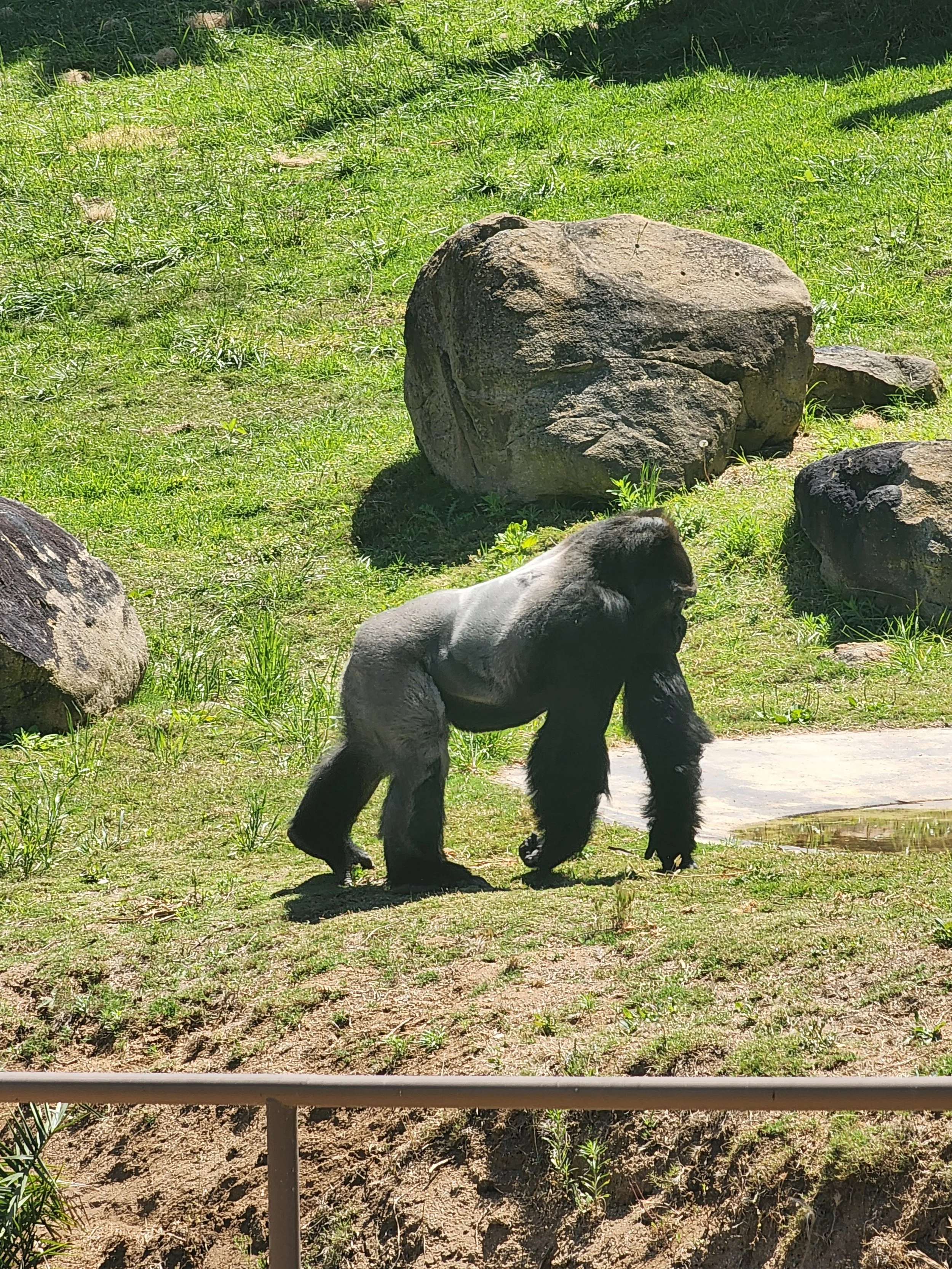
We started with the great silverback gorillas, where we were fortunate enough to see troop leader Paul Donn socializing with the other gorillas. Sadly, only a week after our visit, Paul Donn suddenly fell ill and passed away.
The way our guide spoke so lovingly about the gorillas signaled to me immediately that this was going to be an amazing tour.
At every habitat, we learned the animals' names, a little about their personalities, and were encouraged to ask as many questions as we wanted. This was not a guide reciting memorized facts. This was someone who genuinely loved these animals and wanted us to love them too.
We eventually made our way onto the African savanna, where the safari experience really came alive. We traveled through areas accessible only to safari tours, stopping often to observe the animals and learn about their behavior.
At one point, a military helicopter passed overhead. This seemed to alarm our guide. He explained that the protected airspace above the park means this is an extremely rare event, and that we should stay to watch the animals’ reactions.
Most of them froze.
The babies ran toward their mothers.
One particularly large white rhino froze in place and lifted her head toward the sky. Our guide giggled and explained that she could not actually see the helicopter. It was too far. Instead, she was trying to smell it.
Within minutes, everything returned to normal. The animals resumed grazing, wandering, wallowing in mud, and generally carrying on as though nothing had happened.
A Baby Deer Meets the World
Eventually, we crossed into the Asian plains, where we had one of the day's most memorable moments.
As we were watching all the different species out there coexisting happily, our guide suddenly grew very excited and pointed toward a distant hill.
“Oh my! Everyone look!”
We all followed his directions and patiently waited to see what was so exciting.
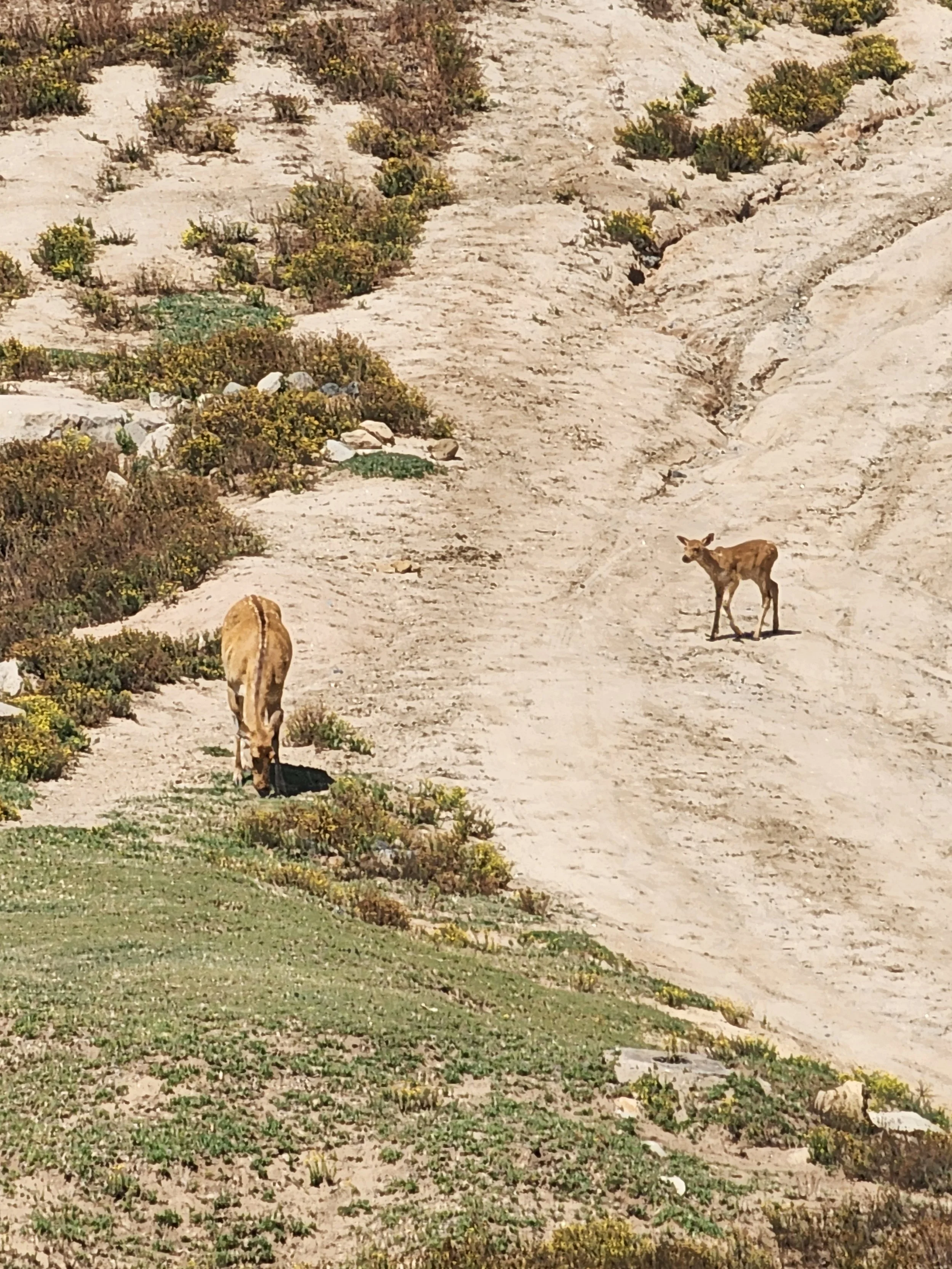
Slowly, a female Père David's deer appeared with her baby.
Our small group let out a collective “Awwwww”.
This was a momentous occasion. This was the first time mama deer had brought the baby out of hiding and allowed the other animals on the plain to meet her youngster. It was also the first time our guide had ever seen the baby.
Needless to say, he was absolutely giddy.
These deer are extinct in the wild, having been hunted to extinction in China. Through extensive conservation efforts worldwide, including breeding programs descended from a single remaining private herd owned by a British nobleman, there are now roughly 10,000 living Père David's deer.
This particular birth marked the first successful Père David's deer birth at the Safari Park in twenty-two years.
We stayed glued to our seats as different species slowly and gently approached the baby, sniffed it, and wandered away. It felt like we were watching a scripted scene from The Lion King.
It was fabulous, even if Rafiki did not show up.
We learned so much throughout the rest of the safari about feeding programs, healthcare, enrichment activities, and the training used to help animals comfortably participate in their own medical care. We even watched a keeper driving slowly across the plains, stopping periodically to toss fresh fruits and vegetables while quietly checking on the various animals.
After the safari portion of the tour, we passed through a huge wooden gate that looked exactly like the one from Jurassic Park. We learned that Spielberg actually modeled his famous gate in the movie after the one at the Safari Park.
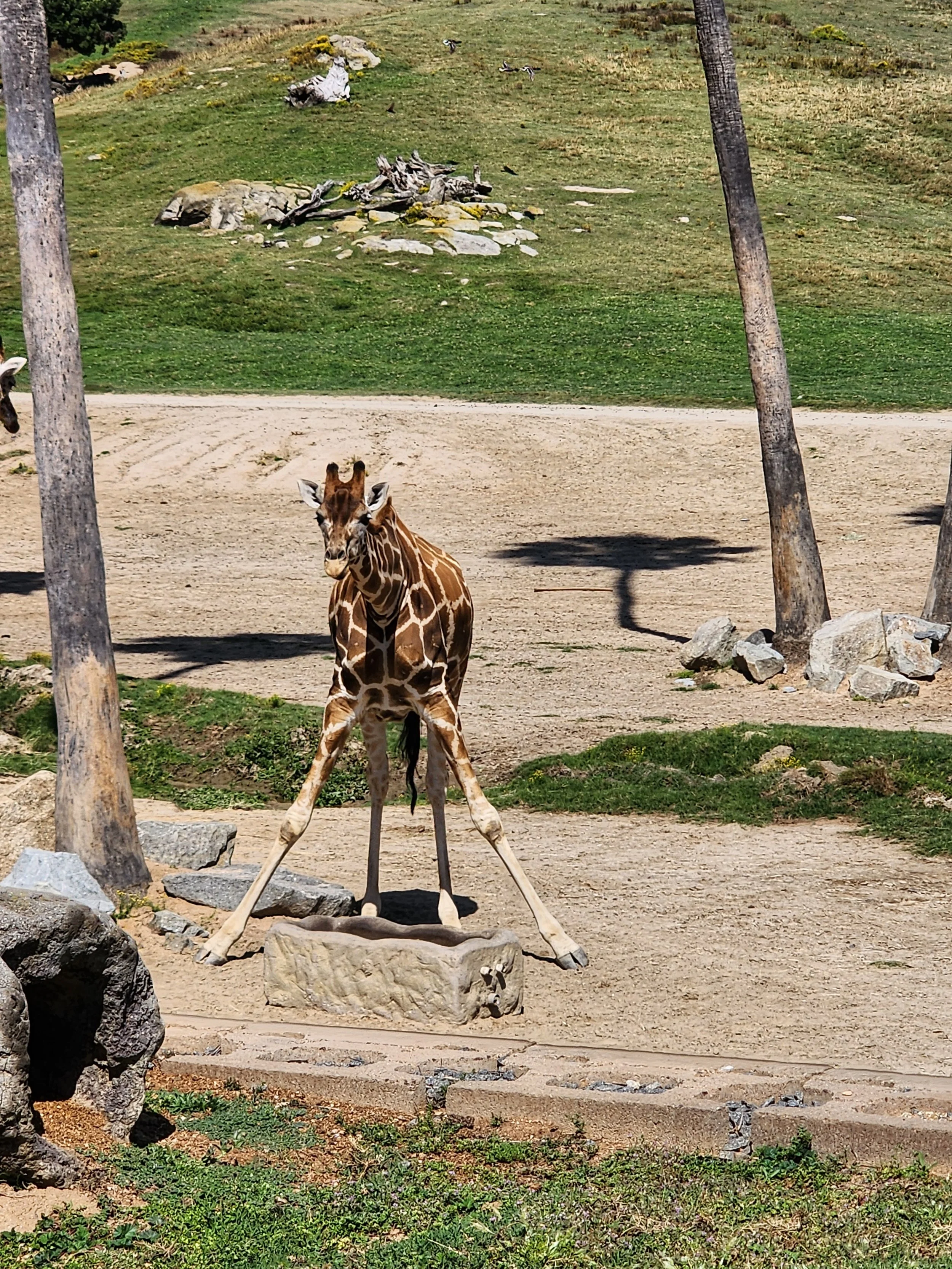
In this section, we encountered even more animals, many of them much closer than before. We watched a giraffe assume the awkward position required to drink water and passed the largest flock of Greater Flamingos in North America.
The tour lasted closer to two hours than ninety minutes. Our guide apologized, but none of us were even slightly upset. We had witnessed some incredibly special moments that day, and every extra minute had been worth it.
Why Places Like This Matter
After the tour, we grabbed a hot dog for a late lunch.
One of the things I genuinely appreciate about the Safari Park is that visitors are not required to spend additional money once they arrive. You are welcome to bring your own lunch, snacks, and drinks, and get your water bottle refilled as many times as you want at any of the vendor stations throughout the park.
Little things like that make purchasing a membership feel even more worthwhile. As someone who enjoys budget travel and budget adventures, I appreciate places that make it easy to explore without constantly reaching for your wallet.
We spent the remainder of the afternoon visiting some of the smaller exhibits throughout the park, including Newman the sand cat, who was bouncing around like a kitten. He is an adult and is literally less than half the size of our cat, George.
We finished our day exploring the aviaries and enjoying an afternoon of birdwatching before the park closed.
As we walked back to the car, we both realized that, aside from the safari tour itself, we had spent most of the day on our feet.
As Mr. Whaldo says, the dogs be a barking.
On the drive home, we talked about everything we had learned and everything we had seen.
In my quiet moments, I find myself thinking about that day, what we learned, and what we were lucky enough to see. Mr. Whaldo and I are currently working on our itinerary for an expansive African safari, and while there is nothing quite like experiencing animals in the wild, many of the animals we encountered at the Safari Park are species we may never have the opportunity to observe in their natural habitats.
That realization left me grateful.
Grateful for the people dedicating their lives to conservation. Grateful for places like the San Diego Zoo Safari Park that connect people with wildlife. And grateful that somewhere, a little platypus is swimming through the dark, a baby giraffe is discovering its legs, and a family of elephants is still looking after one another.
We still have to make our way back to the San Diego Zoo so I can finally conquer that map, but there is still so much left to do on our San Diego staycation adventures.
It's a good thing we live here.
-J.S. Whaldo
